Coca-Cola CHOK!: when the television advert became the game
An editorial analysis of a public campaign, not a Tapmello customer case study.
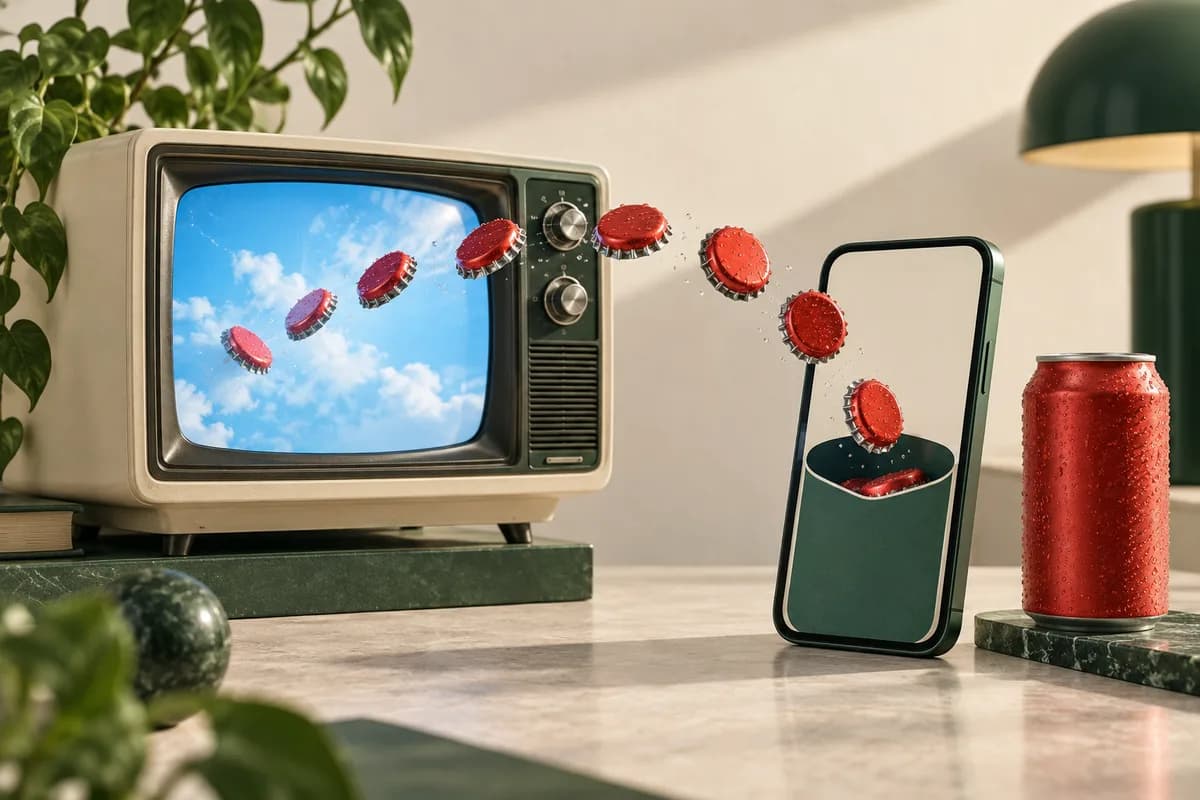
A Coca-Cola commercial at 10pm. A phone ready to catch bottle caps. The advertising break had become the game.
See the example for your businessa QR at an exhibition stand, a short game and a gift.
The important design question starts before the first tap: what is the customer doing when they notice your invitation, and why would they stop?
In this case study
Reported figures
Campaign period: Hong Kong, 2011 · creator’s account published March 2012
The advertisement became the invitation
The HKMA/TVB award report describes an app linked to a 10pm commercial: people swung their phones to catch virtual bottle caps and win prizes. A familiar advertising slot became a scheduled participation moment. [2]
Our interpretation is that the clever move came before the prize. A television advert normally interrupts something people chose to watch. Here, the advert supplied the action they were waiting to perform. The bottle cap connected that action to a recognisable part of the drink, while the phone gave the viewer a role in the scene.
The two screens also had different jobs. Television made the event visible; the phone made participation personal. That is a useful way to think about interactive advertising: the large surface does not need to become a complicated interface. It needs to give someone a compelling reason to use the small screen already in their hand.
People still have to encounter the invitation
The award account also describes concentrated mobile, online and television promotion during the first three days. Distribution was part of the campaign, not something the game replaced. [2]
That is a practical distinction when budgeting a pilot. Creating a link does not create foot traffic, an audience for a social post or a place to display a QR. Choose a surface you can actually use, then check whether the intended customer can see it at a useful moment.
The launch is worth studying as a connected sequence: discover the invitation, understand when to join, have the phone ready, then act. Advertising that reaches someone after the useful moment breaks that sequence, however attractive the creative is. A small campaign needs the same agreement between its message, its location and the time when the offer can actually be used.
Keep media attention separate from participation
The figures above come from Mark Kong’s account of the work. They describe app downloads and combined media viewing, not the same population progressing through a measured purchase funnel. [1]
The useful business reading is that the work generated attention for the advertising as well as uptake of the app. Those are two different achievements. A memorable media idea can make people want to see the content, while a playable invitation asks them to take an additional step. A report needs to preserve both sides of that story.
For a stand activation, the equivalent questions are practical: did visitors notice the invitation, did they start the activity, and did they reach the employee afterwards? Count starts, claims and handovers separately. This lets the team improve the weak part of the experience instead of celebrating a large total that does not explain what people did.
Write the first sentence for the real situation
Consider a stand where a representative is busy. “Try a short brand challenge while we finish this demonstration” explains both the activity and the wait. Add the actual gift and collection point. This is a proposed exhibition use case; it was not part of the Coca-Cola rollout.
Keep the invitation readable before someone scans. They should not need to open the page to discover that the offer requires a purchase, an email address or collection at a different location. State the material condition beside the QR and repeat it in the game’s terms.
Test the complete route in the actual environment. Can a phone read the code under the venue lights? Does the landing page open on the available connection? Can the employee check the reward without leaving an ongoing conversation? The operational handoff is part of the experience, not an administrative detail added later.
Give the handover one clear purpose
For a first stand activation, the purpose can be modest: make the waiting moment pleasant and introduce the visitor to the team. Use a small, counted gift that is easy to store and distribute. Do not describe every recipient as a sales lead in the report.
If the visitor wants a demonstration or a later conversation, record that request through your normal process. Keep it separate from merely earning a gift. This gives the team a useful distinction after the event: who participated, who collected something, and who actually asked for contact.
Turn a stand sign into a short invitation
Tapmello’s Catch the Launch template turns three falling products into a short invitation and an example gift at a staffed stand. Start with the existing activity before styling it.
Free to customize. 12,500 KZT publishes one game for one calendar month.
How to run the campaign
- Choose the launch template The sample asks visitors to catch three products. Replace all three item pictures, then confirm the gift, quantity and collection hours before publishing.
- Create a placement-specific QR Put it where visitors can pause safely, with a sentence explaining the activity and the collection point.
- Check the published handover Rehearse in the editor first. After publication, have a colleague use the public QR and bring the real code to the employee distributing gifts.
What to measure
Keep placement traffic, game starts, completed rounds, claims and redemptions separate. Record genuine follow-up requests independently of gift participation.
This is an ordinary browser game opened by QR. It does not synchronise with a television commercial or detect phone-swinging gestures like the original CHOK! experience.
Exhibition-stand campaignSources
- Coca-Cola “Chok! Chok! Chok!”Mark Kong · March 29, 2012Creator-reported downloads and combined views; not an independently measured sales funnel.
- HKMA/TVB Marketing Excellence 2012 — page 37Hong Kong Management Association · 2012Campaign description and launch distribution. Printed page 37.